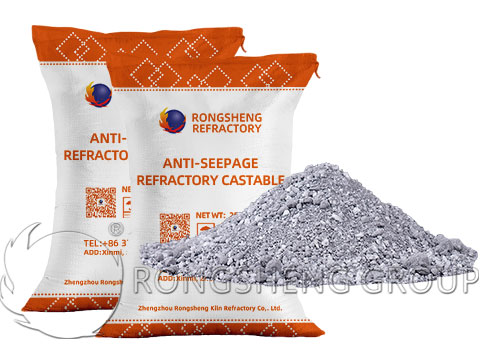
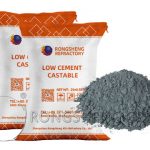
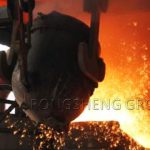
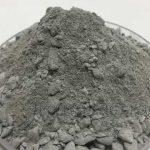
This anti-seepage castable is low in conductivity and impermeable, effectively shielding against molten metal. With a corundum-molybdenum-micron powder framework and incorporating a composite anti-wetting agent, it can operate continuously at 850-1000℃. Its large contact angle and high surface tension with molten aluminum, lead, and cryolite prevent the molten metal from spreading and penetrating, thus limiting erosion to a 2-3 mm surface layer and significantly mitigating deep-seated damage.
This anti-seepage castable can replace brick linings, offering convenient construction. Traditional aluminum melting furnaces often use high-alumina bricks or silicon carbide bricks for their anti-seepage layers, resulting in numerous mortar joints and long furnace drying cycles. The anti-seepage castable is delivered to the site in dry bags, mixed with water, and then pumped or poured. It is formed in one step, requiring no pre-lining or 72-hour baking time, and can be heated and put into operation within 24 hours. This shortens furnace repair time and eliminates the risk of leakage at brick joints.
Specifically designed for electrolytic cells: Blocking sodium and fluoride reactions
In aluminum electrolytic cells, Na and NaF vapors diffuse along the gaps in the carbon bricks above 850℃. They react with conventional refractory materials to form nepheline, accompanied by a 20% volume expansion, leading to bulging and cracking of the carbon bricks.
The anti-seepage castable working layer has an Al₂O₃ content ≥ 45% and SiO₂ controlled at 35-40%, allowing for nepheline expansion. Simultaneously, the material’s microporous structure, in a 950℃×96h cryolite crucible test, resulted in a reaction penetration depth of less than 5 mm, effectively inhibiting further inward migration of sodium vapor and extending the cell life by 8-12 months.
Dual-Layer Function: Insulation and Barrier in One
In the tank bottom structure, impermeable castable refractory is directly laid on top of lightweight insulating bricks, forming a “barrier-insulation” composite layer:
Upper layer: 120-150 mm thick impermeable refractory, resisting molten metal and sodium vapor.
Lower layer: 65-100 mm thick lightweight castable refractory, maintaining the cathode temperature above 850 ℃ and preventing electrolyte crystallization and precipitation within the carbon bricks.
The linear changes of both layers are matched, with hot surface contraction and cold surface expansion complementing each other, maintaining overall volume stability and preventing delamination and cracking.
Thermal shock resistant and adaptable to frequent start-stop cycles.
The electrolytic series requires daily anode exchange and cell pressure adjustment, with temperature fluctuations of 100-150℃. The anti-seepage castable, by introducing appropriate amounts of andalusite and fused mullite, utilizes their high-temperature phase transformation microcrack toughening mechanism. This ensures that after 30 cycles of 950℃ → air cooling, the surface remains free of spalling, and the strength retention rate exceeds 80%, meeting the “low-efficiency, high-current” operating requirements of modern large-scale prebaked cells.
In lead blast furnaces and copper flash furnaces, although the melt is mainly composed of sulfides, the penetration mechanism is similar. Lead smelting uses SiC-C anti-lead seepage material, while copper smelting uses magnesium-aluminum spinel-carbon composite anti-seepage material. Both follow the design principles of “low porosity, high wetting angle, and microcrack buffering” to ensure long-term safe operation of the hearth sidewalls and furnace bottom.
The Anti-Seepage Castable, one of the boiler refractory, with its comprehensive advantages such as low thermal conductivity, impermeability, resistance to sodium corrosion, and quick construction, has become the preferred material for linings of high-temperature non-ferrous smelting furnaces such as aluminum electrolytic cells, lead melting furnaces, and copper melting furnaces. With the increasing size of furnaces and the improvement of smelting strength, further optimization of volume stability and thermal shock resistance will be the core direction for the continued development of boiler refractory. Contact Rongsheng to obtain free samples and quotations for boiler refractory.