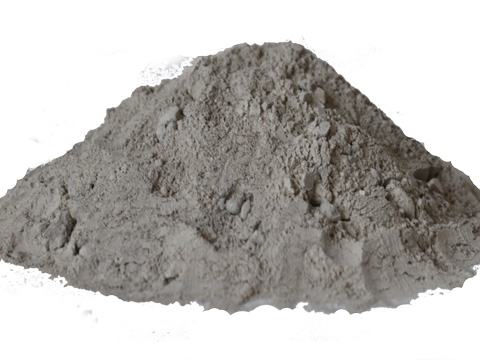
The material composition of refractory spray coatings is basically similar to that of similar refractory castables. The difference lies in the smaller critical particle size of the refractory aggregate, typically 3-5 mm, and the application method is spraying. The combined amount of refractory powder, ultrafine powder, and binder is relatively high, generally 35-45%.
Spraying is performed using a spray gun or spray machine. The material, aided by compressed air, achieves considerable velocity and is propelled through the nozzle onto the target surface, forming a robust coating. The key technical aspects of refractory spray coatings are adhesion, bonding, strength, and sintering properties. These are also fundamental characteristics that the material should possess; otherwise, the service life of the refractory coating will be reduced. These characteristics are not only related to the quality of the material itself but are also influenced by the spraying equipment, application process, and the condition of the target surface.
The bulk density of heavy-duty refractory spray coatings is generally greater than 1.8 g/cm³. Refractory aggregates and powders are generally made of aluminosilicate materials, with a critical particle size of 5 or 10 mm. Particle composition: approximately 30% for 3-5 mm, approximately 30% for 1-3 mm, and approximately 40% for less than 1 mm. Aluminate cement and water glass are used as binders, along with additional admixtures. Semi-dry or pseudo-dry application methods are generally used. The main performance indicators of heavy-duty refractory castables are shown in Table 1.
Table 1. Main Performance Indicators of Heavy Refractory Castables
Items
1
2
3
4
Compressive Strength MPa
1d
22
19
15
110℃
21
24
23
26
800℃
18
21
28
35
1300℃
35
35
38
81(1400℃)
High-temperature Flexural Strength MPa (1300℃)
2.8
3.4
4.2
–
Load Softening Start Temperature ℃ (4%)
1340
1370
1350
1410
Refractoriness ℃
1750
1750
1730
1750
Bulk Density g/cm3
2.23
2.14
2.18
2.65
Number 1 is CA-50 cement-based high-alumina refractory spray coating; Numbers 2 and 3 are CA-50 cement-based and water glass-based clay refractory spray coatings, respectively; Number 4 is phosphate-based high-alumina refractory spray coating. The table shows that the CA-50 cement spray coating exhibits decreased mid-temperature strength, while the water glass and phosphate spray coatings show increased strength with increasing heating temperature. Their bulk density is slightly lower than that of vibration-molded refractory castables of the same type.
In recent years, medium-heavy refractory spray coatings with a bulk density of 1.8–2.1 g/cm³ have been developed. These are made by adding 3%–6% expanded perlite or 5%–20% porous lightweight clinker to a heavy refractory base. They are mainly used in the insulation layer of kilns, providing good thermal insulation.
Lightweight Refractory Spray Coatings
There are many types of lightweight refractory spray coatings, mainly including clay-based, ceramsite, and perlite refractory spray coatings. Lightweight refractory spray coatings are primarily used as insulation layers in kilns, and can also be used in the working layers of tubular furnaces, flues, and chimneys.
The critical particle size of the refractory aggregate in lightweight refractory spray coatings is 5 mm. The particle size distribution is: 3-5 mm approximately 19%-30%, 0.6-3 mm approximately 8%-14%, 0.088-0.60 mm approximately 30%-40%, and less than 0.088 mm approximately 25%-35%. The main performance indicators of lightweight refractory spray coatings are shown in Table 2.
Table 2. Main Performance Indicators of Lightweight Refractory Spray Coatings
Items
1
2
3
4
5
Bending Strength MPa
3d
4.5
–
15
–
–
110℃
4.9
3.6
7.3
1.0
0.8
High-temperature Flexural Strength MPa
1.2
1.5(1200℃)
1.9(1000℃)
–
–
Load Softening Start Temperature ℃ (4%)
1300
–
1280
–
–
Refractoriness ℃
1650
–
1550
–
–
Bulk Density g/cm3
1.7
1.34
1.32
0.93
0.72
Lightweight Refractory Spray Coating No. 1 is spray-formed, with the following mix proportions: 45%–50% clay clinker particles, 4%–7% perlite particles larger than 1.0 mm, 25% high-alumina powder, 22% CA-50 cement (No. 525), 4% spodumene, and appropriate amounts of additives and water.
Lightweight Refractory Spray Coatings No. 2, 3, and 4 are vibration-formed.
No. 2 is prepared using CA-50 cement (No. 525), porous clinker, high-alumina powder, and appropriate amounts of perlite.
No. 3 has the following mix proportions: 18%–22% 1–5 mm clay ceramsite, 10%–13% clay clinker or waste clay brick particles larger than 3 mm, 4%–6% expanded perlite, 35%–40% clay powder, 20%–25% CA-50 cement (No. 525), and appropriate amounts of water. The mixing ratios for No. 4 and No. 5 are as follows: 50-60% shale ceramsite, 3-8% expanded perlite, 7-15% clay powder, 27-35% CA-50 cement (No. 525), and an appropriate amount of water.
During the application of refractory spray coatings, the rebound and scattering of refractory aggregates and the splashing of refractory powder can significantly alter the original particle size distribution. Therefore, when the aggregate size requirements for refractory spray coatings are fixed, the original particle size distribution before spraying must be adjusted to meet the requirements after spraying in order to achieve the desired aggregate size distribution in the final sprayed coating. This change in the particle size distribution of refractory aggregates is shown in Table 3.
Table 3. Changes in particle size distribution of refractory aggregates
Items
1.2 -5mm
0.3-1.2mm
>0.3mm
Aggregates
Requirements
Actual
After spraying
Requirements
Actual
After spraying
Requirements
Actual
After spraying
Refractory clinker
42
50
39
38
37
39
20
14
21
Vermiculite
15
32
27
15
22
34
30
26
40
Ceramic granules or lightweight gravel
40
38
27
20
40
34
20
22
40
Before applying the spray coating, a trial spray should be conducted according to the application instructions provided by the manufacturer for that particular grade of spray coating to determine suitable parameters, such as air pressure and water pressure.
Several Commonly Used Spray Coatings
(1) When spraying clay materials at room temperature, the aggregate particle size should be below 3.5 mm. When the spray coating lacks viscosity, 2% clay should be added to improve its workability.
(2) When spraying high-alumina materials at room temperature, additives should be added to prevent sagging and increase the density of reinforced metal parts.
(3) When using lightweight thermal insulation materials for spraying, high-strength lightweight aggregates should be used, and appropriate amounts of asbestos and clay should be added. Aggregates with low strength, easily broken under pressure and friction, or elastic aggregates are not suitable for spraying. The bulk density of lightweight thermal insulation spray coatings should be between 0.7 and 1.3 t/m³.