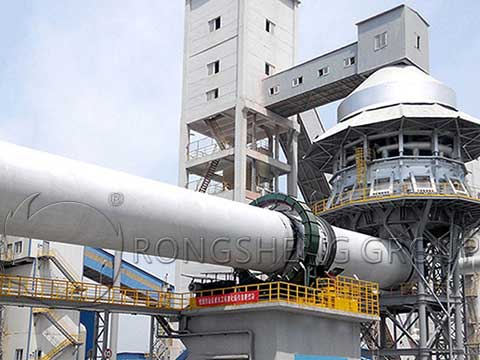
With continuous updates, rotary kiln lining materials are no longer limited to a single method. Currently, there are refractory brick linings, monolithic refractory castable linings, and linings made of a 50/50 mix of precast components and castables. Furthermore, the refractory insulation system is constantly being upgraded, resulting in lower kiln surface temperatures and greater energy efficiency.
Structure of Rotary Kiln Refractory Insulation and Working Layers
Is it better to make the refractory insulation and working layers a composite structure, or to make them separately? Opinions vary. However, in practical use, a composite approach is generally better than making them separate inner layers.
Using precast components and castable refractory as linings provides better performance and is easier to construct than using castable refractory alone. Based on actual usage, a composite approach is still better than separate insulation layers.
The reason why using precast castable refractory composites for the refractory insulation and working layers results in better performance is that the two working layers are made into a single, integral working layer. During the production process, they are baked at a certain temperature to become a single precast brick. The advantage is that the two layers are combined into one, preventing separation. Furthermore, both working layers are constructed in one go during construction, saving manpower and time, without compromising performance, and with enhanced overall integrity.
Independent Structure of Rotary Kiln Insulation and Working Layers
Constructing the refractory insulation and working layers separately, or attaching the lightweight insulation portion to the heavy working layer, can lead to issues such as detachment, accumulation, or moisture in the castable refractory affecting insulation performance. As the rotary kiln rotates, the stress effect of a single, integrated lining is less effective than that of a two-layer lining. Furthermore, when fiberboard is attached to the heavy layer and interfacing with the castable refractory, some moisture may seep out during baking, reducing the fiberboard’s insulation performance and impacting its overall refractory insulation quality.
In contrast, a composite, integrated lining is more robust than separate or bonded precast components, and its construction is also more convenient and faster.