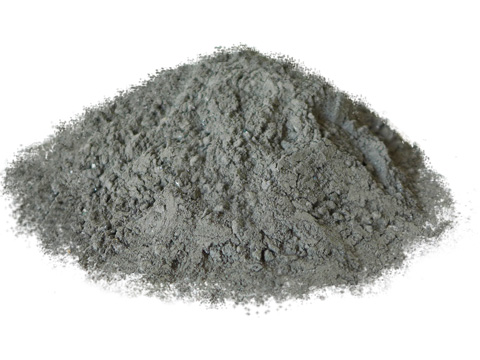
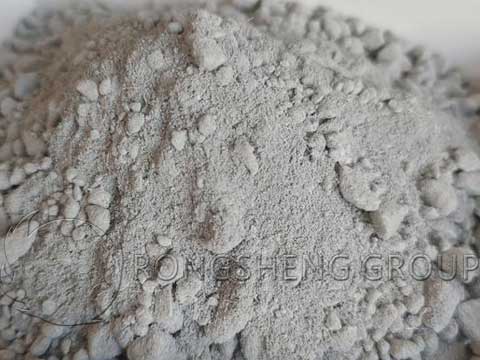
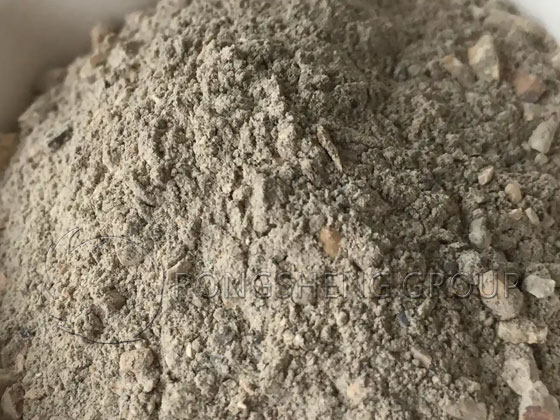
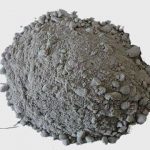
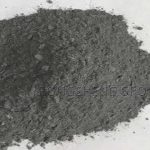
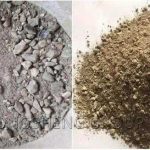
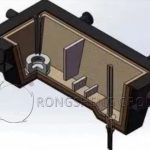
Dry ramming mass is a cost-effective dry vibrating material composed of premium-grade calcined bauxite, corundum, spinel, magnesia, and sintering agents. It is suitable for melting carbon steel, alloy steel, stainless steel, and high-manganese steel, offering a long service life and excellent cost-performance.
Dry ramming mix does not contain water or liquid binders. It forms a dense and uniform whole solely through the effect of vibration. Its strength is developed by thermosetting binders or ceramic sintering agents during heating. The material utilizes high-iron, high-calcium synthetic magnesia and fused magnesia as aggregates and fine powders, with the dicalcium ferrite (C2F) component of the synthetic magnesia acting as a sintering aid; it is formulated using multi-stage particle grading without the addition of external binders. Intensive ramming ensures high post-installation density, allowing the material to sinter into a solid monolith at appropriate temperatures; its service life is several times longer than that of traditional ramming or brick-laying methods. Typically, the single-campaign service life of dry ramming mass exceeds 300 heats, and this can be extended to 500–600 heats through hot repairs. This not only reduces the frequency of furnace shutdowns but also significantly lowers refractory material consumption per ton of steel produced.
Types of Dry Ramming Masses
Types of dry ramming masses include: acidic (silica sand/quartzite, zircon-based), neutral (corundum-based, mullite-based), basic (magnesia-based, magnesia-alumina-based), and carbon- and silicon carbide-containing varieties (corundum-silicon carbide-carbon, alumina-carbon, magnesia-carbon, magnesia-calcia-carbon, etc.).
They exhibit appropriate expansion characteristics; the expansion and contraction behavior prevents the formation of excessive cracks—thereby minimizing the infiltration of molten steel and slag—while also avoiding localized lifting caused by shrinkage-induced cracking, thus ensuring continuous furnace operation. High natural bulk density and fired density prevent density non-uniformity during installation and sintering while providing superior resistance to penetration and erosion by molten steel and slag. They offer strong resistance to erosion by molten steel and slag, characterized by low and uniform erosion rates and a long service life. The material bonds effectively with the hot face of the existing furnace bottom, ensuring successful repair results.
Neutral dry ramming masses are generally selected for the furnace body of cored induction furnaces. The specific dry ramming material used for the inductor varies depending on operating conditions. Neutral dry ramming masses are commonly used in non-ferrous metal smelting furnaces, whereas basic or neutral dry ramming masses are typically employed in ferrous metal smelting furnaces.
Dry ramming mixes can be installed using either a direct ramming method or a direct vibration method. The direct ramming method involves using a rammer to compact the refractory material directly; after a layer is fully compacted, the surface is raked to loosen it before a new layer of material is added and subsequently compacted. This layering process continues until installation is complete. Although time-consuming, this method prevents delamination between layers. The direct vibration method utilizes vibration force generated by rammers attached to the inner or outer formwork; this force is transmitted through the formwork to the refractory material, thereby densifying the mix.
Regarding the selection of refractory materials for the working layer of electric furnace bottoms, magnesia-based dry ramming mixes are currently widely used for high-power and ultra-high-power electric furnaces. Because this working layer is in direct contact with molten steel and slag, it is subjected to high thermal loads, slag corrosion, molten steel erosion, and mechanical impact from scrap metal. Additionally, oxidation and reduction operations at high temperatures allow slag to penetrate the furnace bottom, leading to thinning. During periods of intermittent operation, dicalcium silicate within the slag absorbs atmospheric moisture, causing it to disintegrate and spall; this reduces material durability and shortens service life. Therefore, the refractory material in this layer must exhibit excellent sintering properties: it should sinter rapidly at the required temperature to form a sintered layer of sufficient strength and thickness to withstand the mechanical impact of the furnace charge.
The packed density of the formed dry ramming mix is closely related to pre-compaction, as well as the magnitude of the vibration force, vibration frequency, and the number of vibrators used. Pre-compaction increases the initial packed density, and increasing the vibration frequency also enhances density. When the vibration frequency exceeds 50 Hz, increasing the vibration force effectively improves the packed density of the material. When using dry vibrating mixes without pre-compaction, applying vibration forces via two mutually perpendicular rammers can achieve sufficient density.
Dry ramming mixes utilize high-iron, high-calcium synthetic magnesia and fused magnesia as aggregates and fine powders (with a maximum grain size of 5–6 mm). They employ the C2F (dicalcium ferrite) component within the synthetic magnesia as a sintering aid; no binders are added, and a multi-stage particle size distribution is used. Intensive ramming ensures the required post-installation density, allowing the material to sinter into a solid, monolithic structure at appropriate temperatures; its service life is several times longer than that achieved by traditional ramming or bricklaying methods.
Theoretical Basis for the Application of Magnesia-based Refractory Ramming Masses
Magnesia-based Ramming Masses
Unshaped refractories are materials that can be used directly without prior firing; they offer advantages such as rapid installation, simplified processing, energy efficiency, structural integrity, and ease of replacement, making them widely used in the metallurgical industry. Ramming mass is a specific type of unshaped refractory installed via manual or mechanical ramming. It is formulated from a high proportion of granular material and a low proportion of binder (along with other additives) and hardens when heated above ambient temperature. The use of magnesia-based ramming masses in electric furnace roofs and the copper water jackets at the flue gas outlets of oxygen-enriched side-blown furnaces not only meets operational requirements but also reduces production costs.
Drying and Curing of Magnesia-based Ramming Masses Before Use
During the drying process prior to use, surface moisture in unshaped refractories evaporates first; heat conducts from the surface inward, gradually raising the temperature of adjacent sections. As surface moisture evaporates, internal moisture (in the form of vapor) gradually diffuses toward the surface to replenish it. If the heat input is excessive or the temperature rises too rapidly, an excessive amount of vapor is generated within a short period. Due to the relatively low permeability of unshaped refractories, the outward diffusion of internal moisture (vapor) is impeded. Simultaneously, the rapid expansion in volume caused by moisture vaporization generates significant internal tensile stress. If this stress exceeds the material’s compressive strength, cracking occurs; if the disparity is extreme, spalling or explosive rupture may result. Consequently, conventional high-temperature drying methods impose strict requirements and often fail to guarantee optimal material performance. The magnesia-based ramming mass in question can be air-dried at ambient temperature, thereby avoiding heat-induced damage and effectively ensuring the material’s performance.
Principles of High-Temperature Application for Magnesia-based Ramming Masses
The magnesia-based ramming mass used here is prepared by mixing magnesia grains (aggregate) and magnesia powder (fines) in specific proportions with a binder of a certain density; its primary constituent is MgO. Its thermal properties are as follows: melting point of 2825°C, thermal conductivity of 45 W/(m·K), thermal expansion coefficient of 14 × 10⁻⁶/°C, heat capacity of 53.6 J/mol at 1500 K, and excellent thermal shock resistance.
MgO exhibits good high-temperature performance. The magnesia-based ramming mass contains small amounts of CaO and Fe₂O₃. Under production conditions, the CaO and Fe₂O₃ within the ramming mass react to form dicalcium ferrite (C₂F) according to the following equation:
2CaO + Fe₂O₃ = 2CaO·Fe₂O₃
(1) The melting point of dicalcium ferrite is 1449°C; however, in the presence of molten iron (generated by the decomposition of high-valence iron at high temperatures), the temperature at which a liquid phase appears drops to approximately 1100°C. Since magnesia-based ramming masses typically contain small amounts of SiO₂ and Al₂O₃, the temperature of liquid phase formation is even lower than 1100°C. Under production conditions (such as electric furnace operations), a liquid phase begins to form locally within the ramming mass at 1100°C, initiating the sintering process. As the furnace temperature rises, the volume of the liquid phase increases, and the working surface of the material continuously sinters and solidifies, forming a dense sintered layer.
(2) At high temperatures, the C₂F in the liquid phase undergoes a phase transformation to form a new phase with a high melting point, thereby enhancing the material’s stability at elevated temperatures.
(3) Upon heating to high temperatures, the primary component MgO transforms into a stable cubic crystal structure (periclase). According to the CaO-FeO-MgO phase diagram, when the FeO-rich liquid formed by C₂F decomposition comes into contact with a large amount of periclase, the FeO is gradually absorbed by the periclase to form a solid solution [(Mg, Fe)O, or magnesiowüstite]. As homogenization proceeds, the melting point gradually rises. Meanwhile, CaO reacts with the SiO2 present in the material or the slag to form silicate phases with relatively high melting points—such as C2S and C3S—thereby enhancing the material’s high-temperature stability as well as its resistance to corrosion and erosion.