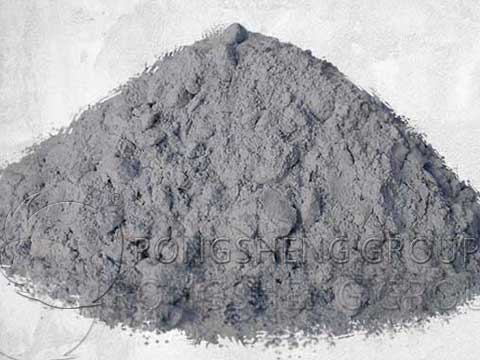
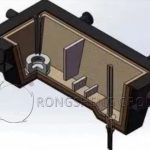
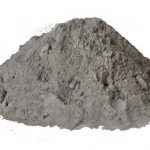
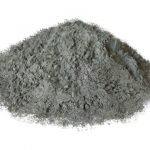
Self-flowing refractory castable represents the latest, fourth-generation advancement in refractory materials. Developed based on the theory of solid-state fluid dynamics, this high-tech product allows for casting without the need for vibration, resulting in a structure that is both dense and uniform.
Rongsheng Self-Flowing Castable
Self-flowing castables achieve their flow characteristics—without the need for vibration—by utilizing their own weight. This is made possible through the incorporation of composite ultrafine powders and high-efficiency additives, combined with precise formulation based on the principle of maximum particle packing density; these elements generate an internal potential difference that causes molecular repulsion. Compared to vibration-cast materials, self-flowing castables offer the following advantages:
First, because the material flows, degasses, levels, and densifies under its own weight, the working environment is improved, and the time required for furnace lining installation is reduced.
Second, the material is convenient to install on-site, allowing for easier quality control and ensuring the airtightness and reliability of the heating furnace.
Third, after installation, the material exhibits more uniform particle distribution, superior structural integrity, consistent quality, and an extended service life.
This product serves as an upgraded replacement for low-cement and ultra-low-cement castables and is particularly well-suited for applications such as furnace roofs, furnace walls, and thermal insulation wrapping systems for water-cooled pipes in various heating furnaces.
Self-flowing Refractory Castable for Heating Furnaces
The self-flowing refractory castable for heating furnaces utilizes bauxite clinker (including Grade I material) and mullite as aggregates. The fine powder components consist of special-grade bauxite clinker powder, corundum powder, and mullite powder, supplemented by α-Al₂O₃ and SiO₂ ultrafine powders and an expansion agent; calcium aluminate cement serves as the binder, combined with a phosphate-based water reducer.
Although the water requirement for self-flowing castables is slightly higher than that of vibration-placed low-cement castables of the same material composition, the self-flowing variety still exhibits excellent performance—specifically, high strength and minimal linear change after firing. Its ability to self-level and effectively release air stems from optimized particle size distribution, which achieves maximum packing density. The rational selection and dosage of binders, ultrafine powders, and water reducers effectively mitigate the potential drawbacks of higher water content, thereby enhancing overall performance.
With the constituent materials, mix proportions, and water content held constant, adjusting the dosages of α-Al₂O₃ and SiO₂ ultrafine powders—while maintaining a combined total of 7%—reveals specific trends. As the SiO₂ ultrafine powder content increases, the flow value rises sharply before leveling off; flexural strength after firing shows little variation but exhibits an optimal peak; and linear change after firing shifts from a negative value to a positive value before undergoing sharp shrinkage. An SiO₂ ultrafine powder content of 3%–5% (corresponding to 4%–2% α-Al₂O₃ ultrafine powder) yields a flow value of ≥180 mm and superior physical-mechanical properties.
When the constituent materials and water content remain constant, increasing the cement dosage necessitates a corresponding reduction in fine powder content. As the CA-70 cement dosage increases, the flow value decreases, and the linear change after firing at 1450°C shifts from positive (linear expansion) to negative (linear shrinkage). This occurs because a higher cement dosage increases the consumption of free water during hydration, raising the castable’s viscosity and lowering its flow value and density, ultimately causing the linear change to shift from expansion to shrinkage. Thus, the optimal cement content is 2%–6%, at which the castable exhibits the best flow value and physical properties.
What is corundum self-flowing refractory castable?
Corundum self-flowing refractory castable is a type of unshaped refractory material primarily composed of corundum aggregates, fines, and additives. Its most distinctive feature is the ability to flow under its own weight without the need for vibration; it spreads automatically and can reach areas that are difficult for vibratable castables to access. It offers ease of installation and excellent flowability, while also providing high wear resistance and resistance to scouring and erosion.
The physicochemical properties of corundum self-flowing refractory castable are as follows:
Its Al₂O₃ content is typically above 90%, and its bulk density after drying at 110°C generally ranges from 2.85 to 3.05 g/cm³. Cold crushing strength is usually around 30 MPa, cold modulus of rupture is approximately 4 MPa, and the abrasion loss value is less than 5 cm³. The self-flow value typically ranges from 170 to 210 mm (self-flow method) or 200 to 220 mm (flow table method). Common grades include SF90 and SF92; in addition to differences in alumina content, these grades vary in bulk density and crushing strength, so the appropriate grade should be selected based on actual operating conditions.
Due to its self-flowing characteristics, this material is widely used in applications such as circulating fluidized bed (CFB) boilers, ladle bottoms, boiler protection tubes, heating furnaces, and blast furnace iron runners. Since these areas are often difficult to line using conventional methods, corundum self-flowing refractory castable helps improve installation efficiency and ensures reliable performance in service. It is particularly widely used in CFB boilers, demonstrating excellent performance in components such as the furnace chamber, refractory-lined water wall sections (stud-tube zones), suspended panels, and cyclone separators—especially in the thin-walled furnace linings of these areas.