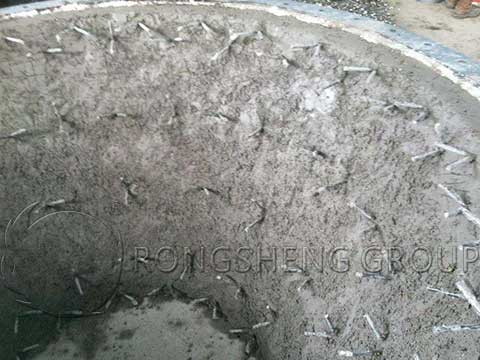
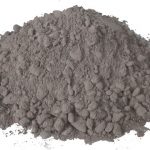
Yes. Low-cement castables are suitable for industrial kiln walls. Besides industrial kiln walls, they can also be used in power plant boilers and chemical plant incinerators. Clay-based and high-alumina low-cement castables can be used as linings for heating furnaces, soaking furnaces, various heat treatment furnaces, and rotary kilns. Mullite-based low-cement castables can be used as linings for various high-temperature burners and for water-cooled tube wrapping in heating furnaces. Corundum-based and chromium-containing corundum-based low-cement refractory castables can be used as linings for the triangular area of the roof of electric arc furnaces in steelmaking.
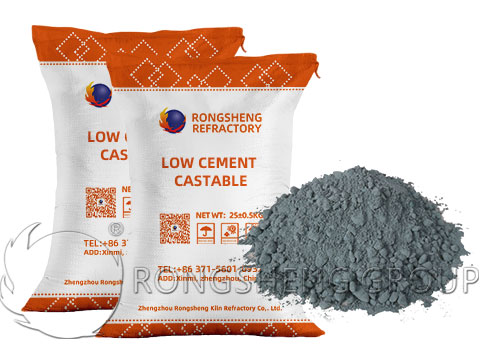
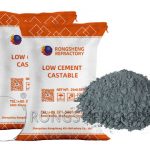
Rongsheng Low-Cement Castables
Low-cement castables are composed of several dense refractory aggregates, fine powder, binders, additives, and liquid, with a CaO content of less than 2.5%. They are prepared using a comprehensive set of technologies, including reduced cement content, ultrafine powder technology, proper aggregate feeding design, and the selection of highly efficient surface-active additives. Compared to traditional refractory castables, they feature “low cement content; higher density and lower porosity; higher room-temperature curing strength; good volume stability; and minimal volume shrinkage after drying and calcination.” Low-cement and ultra-low-cement castables are made from materials such as clay, high-alumina, mullite, corundum, and carbon- and silicon-carbide-containing materials.
Low-cement castables are arguably the most common and predominant type of refractory castable. Advanced ultrafine powder application technology significantly improves the intermediate-temperature strength and high-temperature volume stability of the castable. This process enables the product’s microstructure to form a robust anchor-shaped multi-directional crystal structure at high temperatures, ensuring the overall structural stability of the lining and extending its service life by three times compared to traditional castables.
Low-Cement Castables for Cement Kilns
Requirements for Refractory Material Configuration and Selection for Various Parts of a Cement Rotary Kiln.
Refractory Materials for the Tertiary Air Duct of a Cement Kiln
The Y-shaped components, elbows, and shut-off valves within the tertiary air duct are subject to severe damage, operating under the most demanding conditions.
Therefore, the refractory materials used here must possess characteristics such as wear resistance, erosion resistance, resistance to alkali and chloride corrosion, resistance to mechanical stress, and good high-temperature stability.
High-strength alkali-resistant bricks, high-strength alkali-resistant castables, wear-resistant castables, precast wear-resistant castables, calcium silicate boards, diatomaceous earth bricks, and lightweight castables can be used for lining this area.
Refractory Materials for the Kiln Door Hood of a Cement Kiln
The refractory lining here is affected by mechanical stress, its own weight, erosion from high-temperature gases, and material abrasion. When high-temperature molten material is deposited on the surface, it is prone to “snowman” formation.
Therefore, the refractory materials must possess characteristics such as high-temperature resistance, good wear resistance, and good high-temperature volume stability. High-alumina low-cement refractory castables, mullite castables, high-alumina bricks, phosphate-bonded high-alumina bricks, and calcium silicate boards can be used for lining.
Refractory Materials for Cement Kiln Grate Coolers
Grate coolers are generally divided into a quenching zone, a heat recovery zone, and a cooling zone, typically consisting of three sections.
The upper part and roof lining of the first section can be constructed using high-alumina low-cement castables or mullite castables. The lower walls can be constructed using wear-resistant castables or precast components of the same material.
The upper part and roof lining of the second section can be constructed using high-strength alkali-resistant castables. The lower walls use high-alumina low-cement castables or mullite castables.
The upper part and roof lining of the third section can use alkali-resistant castables, while the lower walls use high-strength alkali-resistant castables.
The refractory lining of the low wall of a general cooler is often subjected to long-term wear from high-temperature clinker, so high wear-resistant castables or high wear-resistant precast components of different materials are often used for masonry.
Refractory Materials for Cement Kiln Inlet Construction
Refractory materials used for inlet construction mainly include various high-temperature performance monolithic refractories such as corundum castables, mullite castables, and andalusite castables.
In new cement kilns or those with minimal deformation at the kiln inlet, shaped refractories such as high-wear-resistant silicon carbide refractory bricks and wear-resistant high-alumina bricks can also be used. Phosphate castables are used for emergency repairs, while corundum mullite castables can be used for major overhauls.
Refractory Materials for Cement Kiln Waste Heat Power Generation Systems
The waste heat power generation system extracts hot air from the cooler and transports it through pipelines to the waste heat power generation boiler for power generation. The hot air temperature generally does not exceed 800℃.
The waste heat power generation system has a high flow rate of hot gas and a high dust content, causing severe wear on refractory materials. Wear is particularly severe in areas such as air intakes, ventilation duct bends, and settling chambers, requiring refractory materials with excellent high-temperature wear resistance. Currently, the main materials used in domestic waste heat power generation systems include brown fused alumina ramming mix, wear-resistant coatings, wear-resistant ceramics, and various wear-resistant castables.
Refractory materials used in cement kiln waste gas treatment systems
Because cement kilns have different configuration systems for treating waste gases, and the types of waste gases treated are also diverse, there is no unified standard for the refractory materials used in these systems.
Based on the current situation of domestic cement kiln waste gas treatment systems, common refractory materials used include high-strength alkali-resistant bricks, high-strength alkali-resistant castables, mullite castables, corundum castables, steel fiber wear-resistant castables, and silicon carbide wear-resistant bricks.