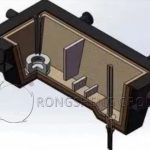
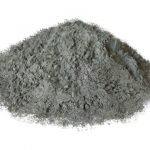
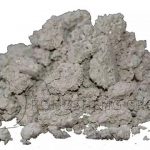
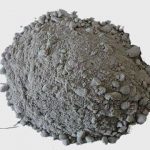
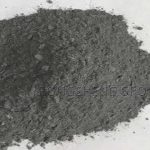
The working lining of the tundish comes into direct contact with molten steel; therefore, it is required to reduce inclusions in the melt, enhance steel purity, and exhibit strong resistance to erosion by molten steel and slag. Additionally, it should facilitate extended casting times for thin-slab continuous casting and allow for easy dismantling after use to reduce labor intensity. Recent trends in the development of tundish working linings are evident in two areas:
(1) In terms of form, there has been a shift from insulating boards to spray coatings and dry vibratable mixes.
(2) In terms of material composition, there has been a move toward magnesia-based and magnesia-calcia-based materials, which serve to purify the molten steel.
Process Requirements for Tundish Dry-Vibratable Material
The tundish dry-vibratable material utilizes a composite binder system comprising a mixture of organic and inorganic binders. Since organic binders decompose and lose their binding capability at certain temperatures, the temperature of the permanent lining must not be excessively high during installation. Specific requirements regarding the working lining thickness and other parameters have been established based on the continuous casting needs of a specific plant: permanent lining temperature should be below 100°C (lower is better); working lining thickness should be 40–50 mm for the bottom, and 45–60 mm for the sidewalls, with a minimum of 55 mm at the slag line; and service life should exceed 12 hours.
Installation Process for Tundish Dry-Vibratable Material
The installation process involves vibration molding followed by heat curing. Installation may proceed once the permanent lining temperature meets the required conditions. First, install the bottom impact plate and well block, ramming them tight with ramming mass; then, pour the dry-vibratable material onto the tundish bottom, ensuring the specified thickness and a level surface. After completing the bottom installation, position the former (mold) and adjust the gap between the former and the permanent lining. Pour the dry-vibratable material into the tundish up to the top rim, activate the vibration motor for 3–5 minutes, and continue adding material and vibrating until the material fills the space up to the rim. Care must be taken to prevent debris—such as packaging bags or plastic liners—from entering the tundish during installation.
Ignite the preheating burners on the former for low-flame heating at approximately 200–250°C for 1–1.5 hours to ensure the powder material in contact with the former hardens and develops sufficient strength. Activate the cooling fan for air cooling; demolding may proceed once the former’s temperature drops below 100°C. Exercise caution during demolding to avoid damaging the installed dry-vibratable lining. After demolding, inspect the working lining surface for defects such as spalling, collapse, or cracking. Finally, install prefabricated components—such as impact pads and dams—as well as the submerged entry nozzle (SEN), ensuring precise and secure installation. After installation is complete, evenly pour the dry-vibratable material around the impact pad and dams. Once the entire installation process is finished, install the stopper rod, and the unit is ready for service.
Preheating Curve for Tundish Dry-Vibratable Material
Since the tundish working lining consists of dry-vibratable material and contains no moisture, it generally does not crack or collapse during high-intensity preheating. During preheating prior to steel casting, the temperature should be kept below 800°C for the first 30 minutes. Subsequently, high-intensity heating to 1100°C may be applied for a duration of at least 70 minutes, but not exceeding 180 minutes. Because the material utilizes an organic binder, prolonged heating can compromise the binder’s properties, accelerate carbon oxidation, and reduce the working lining’s erosion resistance.
Tundish spray coatings (working linings) present the following issues during use:
(1) They are significantly affected by environmental conditions; in winter, moisture removal from the working lining must be managed to prevent freezing.
(2) Installation conditions are poor, and the work is labor-intensive.
(3) Cracks develop during natural curing or pre-heating.
(4) Collapse or spalling of the working lining occurs during pre-heating or the steel casting process.
(5) Resistance to erosion by molten steel and slag is inconsistent.
(6) Severe sintering occurs during extended casting sequences, preventing automatic lining release (stripping).
Compared to spray coatings, tundish dry vibratable mixes offer the following advantages:
(1) They exhibit strong resistance to erosion by molten steel and slag, allowing for prolonged casting sequences and reducing refractory costs per ton of steel.
(2) They are less prone to cracking or collapse during pre-heating.
(3) They can be put into service immediately after installation, accelerating tundish turnover and facilitating production scheduling.
(4) The residual lining breaks apart easily, making stripping simple.
(5) The working lining sinters layer-by-layer during casting while retaining a powdery inner zone; this prevents significant adhesion of steel or slag to the permanent lining, thereby extending the service life of the permanent lining.
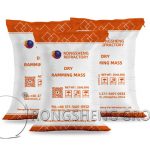
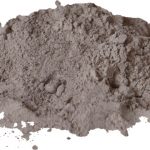
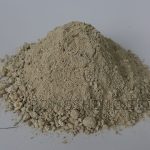
Performance of Dry Ramming Material
To date, a total of 60 dry ramming material working linings have been used, with a maximum of 12 consecutive heats per lining. Post-service inspections revealed an erosion rate of 1–2 mm/h; a sintered layer of approximately 15 mm had formed, while the inner portion remained as loose powder. Regarding lining removal, the material detached easily with virtually no adhesion, causing no damage to the permanent lining.
A comparison of performance between the dry ramming material and sprayed lining material indicates that the dry ramming material offers superior erosion resistance. Analysis of cast billet composition from heats using the dry ramming material confirms that the working lining does not contaminate the molten steel, and no inclusions originating from the lining were detected.
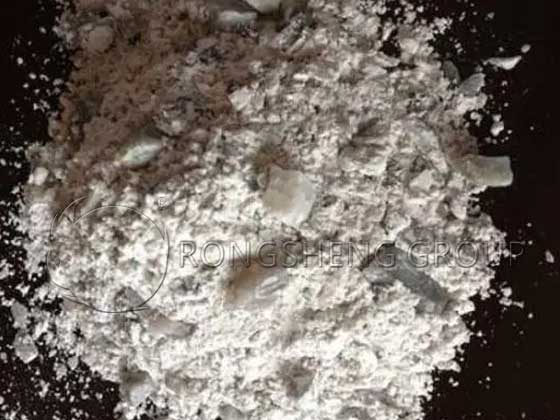
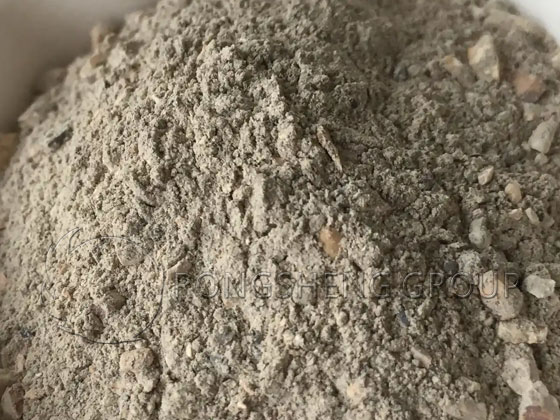
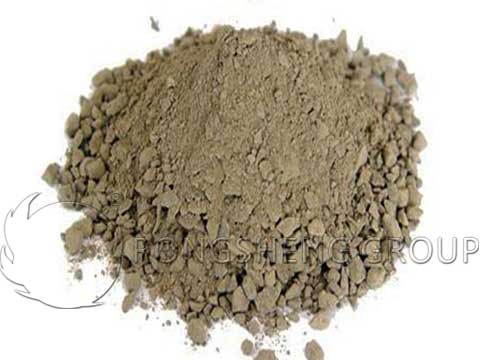
Dry Ramming Material Rongsheng Refractory Manufacturer
Lining pulled out along with the formwork during demolding
After the tundish wall lining was installed, the lining material was pulled out along with the formwork during the demolding process. Analysis suggested the following contributing factors:
(1) Residual material on the formwork had not been thoroughly cleaned off prior to use.
(2) The lubricant applied to the formwork surface was uneven and failed to provide effective lubrication.
By addressing these points in subsequent operations—specifically, cleaning the formwork immediately after use and adjusting the lubricant’s viscosity to ensure proper adhesion—this issue was successfully prevented.
Large cracks appeared on the lining surface after demolding
On two occasions during the use of dry vibratable material, large cracks appeared on the lining surface after demolding. These were typically longitudinal cracks located in the impact zone of the tundish wall, extending from the rim to the bottom and reaching the depth of the powder layer, though they did not compromise operational safety. Analysis suggested the following causes:
(1) Excessive baking time resulted in a thick sintered layer; combined with insufficient cooling time, the surface temperature of the wall remained high during demolding.
(2) After demolding, the lining was directly exposed to ambient temperature, generating shrinkage stress as the wall cooled. Cracks formed when this shrinkage stress exceeded the material’s inherent strength.
To resolve this, the optimal baking temperature, baking duration, and air-cooling time were determined through further testing. Additionally, toughening agents and low-temperature expansion agents were incorporated, effectively controlling crack formation and propagation.
Severe erosion at the slag line
A specific plant currently casts medium-carbon steel using a basic covering agent. Post-operation inspections revealed severe erosion of the working layer at the slag line, with erosion rates exceeding 4 mm/h. The following causes were identified:
(1) Poor erosion resistance of the dry vibratable material. To address this, the material’s formulation was adjusted to enhance its resistance to erosion. Usage has shown that the slag line area exhibits better erosion resistance than the original dry-type material.
(2) Occasionally, due to various factors, the preheating time of the tundish prior to casting is excessively long, leading to oxidation of the surface layer and a consequent reduction in erosion resistance.
(3) Instability in the molten steel composition, excessive slag carryover from the ladle, and delayed slag removal from the tundish result in erosion of the working lining.
(4) The performance stability of the tundish covering agent is poor.